
Latest News
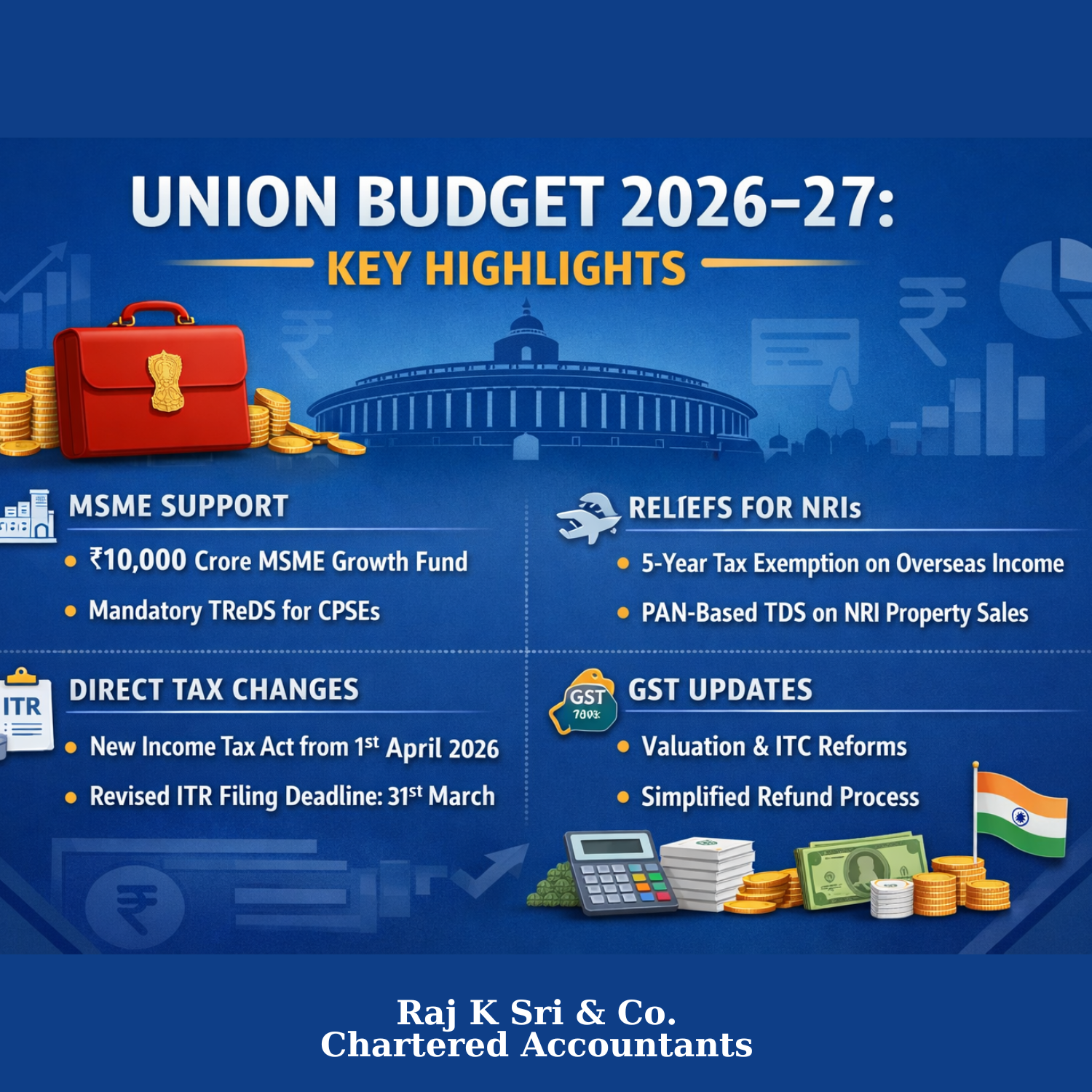
Union Budget 2026
The Union Budget 2026, presented by Finance Minister Nirmala Sitharaman on 1 February 2026, continues the Government of India’s push toward growth, simplification, and compliance ease. While there were no changes to income tax slabs, the Budget introduced a broad set of reforms spanning MSMEs, Non-Resident Indians (NRIs), Direct Tax laws including Income Tax Return (ITR) timelines, and important GST compliance updates.
1. MSME Reforms: Capital, Compliance & TReDS Mandate
₹10,000 Crore Champion MSME Growth Fund
A key initiative announced in Budget 2026 is the creation of a ₹10,000 crore Champion MSME Growth Fund. The objective is to offer equity support, working capital financing, and scaling assistance to high-potential micro, small and medium enterprises (MSMEs), strengthening their competitiveness and access to capital.
Self-Reliance India Fund Top-Up
The existing Self-Reliance India Fund (SRI Fund) will receive an additional ₹4,000 crore in FY 2026-27 to support MSMEs and start-ups.
Mandatory TReDS Adoption for CPSEs
To address delayed payments, a major issue for MSME liquidity, all Central Public Sector Enterprises (CPSEs) purchasing goods or services from MSMEs must now use the Trade Receivables Discounting System (TReDS), ensuring faster realization of dues.
These measures aim to improve credit access, payment discipline, and capacity expansion for MSMEs across sectors.
2. NRI-Focused Tax Relief & Simplification
The Union Budget 2026 introduces significant changes aimed at simplifying tax treatment and compliance for Non-Resident Indians (NRIs):
Five-Year Overseas Income Exemption
NRI professionals visiting India under government-notified programmes will enjoy a five-year tax exemption on overseas income, encouraging global talent participation without domestic tax liabilities on foreign earnings.
PAN-Based TDS for Property Sales
For NRIs selling property in India, the Budget simplifies Tax Deducted at Source (TDS) procedures as Resident buyers can now deduct TDS using PAN (Permanent Account Number), eliminating the requirement for a TAN (Tax Deduction Account Number).
3. TCS Rate Reduction
• TCS (Tax Collected at Source) for education and medical remittances is reduced to 2%.
• TCS for overseas tour packages is reduced to 2%.
4. Direct Tax Reforms
New Income Tax Act, 2025 Effective from 1 April 2026
The Budget confirms that the Income Tax Act, 2025 will replace the Income Tax Act, 1961 from 1 April 2026. Alongside this shift, simplified income tax rules and redesigned ITR forms will be notified to reduce complexity and improve user experience.
Extended ITR Filing Deadlines
Key timeline changes introduced by the Budget include:
• ITR for ITR-1 & ITR-2: Retains due date of 31 July after the end of the assessment year (unchanged).
• ITR for Non-Audit Business/ Trusts: Extended to 31 August.
• Revised Return Filing Window: Extended from 31 December to 31 March following the end of the tax year (for a nominal fee). This gives taxpayers more time to correct returns.
These extensions provide taxpayers, especially wage earners, professionals, and small businesses, greater flexibility and reduce stress around year-end compliance.
Other Direct Tax Changes
Other noteworthy direct tax proposals include:
• Interest awarded by Motor Accident Claims Tribunal (MACT) now exempt from income tax up to specified thresholds.
• Buyback proceeds are now taxed as capital gains with clear treatment and rates per the 2025 Act.
Overall, these reforms aim to simplify the direct tax regime and make compliance more taxpayer-friendly.
5. GST Compliance Updates
Amendments announced in related GST legislation and notifications emphasize compliance clarity and process simplification.
GST Return & Compliance Simplification
Budget announcements reinforce ongoing GST reforms aimed at:
• Digitised and simplified return filing systems, moving toward a more automated and technology-driven GST regime.
• Amendments to valuation rules and input tax credit treatment to reduce disputes.
These GST clarifications help businesses, including MSMEs, manage cash flow and compliance burdens more predictably.
Conclusion
The Union Budget 2026–27 reinforces the government’s focus on economic growth, taxpayer ease, and compliance simplification. From a ₹10,000 crore MSME Growth Fund and mandatory TReDS participation to five-year NRI income exemptions, extended ITR deadlines, introduction of new Income Tax Act and GST compliance enhancements, the Budget delivers targeted reforms for both individuals and businesses.